You've woken up this morning, rubbed your eyes, and tried to read the clock across the room. It looks smeared. You blink again, harder, but the letters remain fuzzy. This isn't just tiredness; it could be a classic case of uncorrected refractive error. Millions of people walk around thinking blurry vision is a normal part of life, when in reality, it's usually an optical mismatch between how your eye is built and how light enters it. Understanding exactly what is going on under your eyelids is the first step toward clearer sight.
Refractive errors are essentially optical imperfections. They happen when the shape of your eye prevents light from focusing directly on the retina, that light-sensitive tissue lining the back of your eyeball. Think of your eye like a camera. If the lens is positioned correctly, the image is sharp on the sensor. In refractive errors, the focus lands either too soon or too late, leaving the picture out of focus. These issues are the leading cause of correctable vision loss worldwide, yet they are often manageable with the right intervention.
The Three Main Players in Blurred Vision
Your eye has three main ways to get the geometry wrong. We call these myopia, hyperopia, and astigmatism. While they all result in blur, the mechanics differ significantly. Knowing which one you have helps you understand why your doctor suggests specific treatments.
Myopia, commonly known as nearsightedness, occurs when your eye is too long relative to its focusing power. Imagine an elongated football shape instead of a sphere. Light entering the eye focuses in front of the retina rather than directly on it. The result? Distant objects look like watercolour paintings, while things close up remain clear. This condition typically develops in childhood, often surfacing around age ten, and stabilises in early adulthood. However, if left unchecked, high levels of myopia can increase the risk of retinal degeneration later in life.
Then there is Hyperopia, or farsightedness. Here, the opposite happens. Your eyeball is too short, or your cornea is too flat. Light tries to focus behind the retina. Surprisingly, mild cases might not show symptoms until you reach your forties because your eye muscles compensate for the strain. Severe cases, however, mean you struggle with near tasks like reading or stitching. It creates a constant feeling of eye strain or headaches after focusing on screens.
Astigmatism complicates things further. Unlike the first two, this isn't about length. It's about surface irregularity. Instead of being shaped like a basketball, your cornea or lens looks more like a rugby ball. This means light hits multiple points on the retina instead of one single spot. You get distorted vision at any distance-near or far. Straight lines might look curved, and night driving becomes hazardous due to starburst effects around lights.
How Corrective Lenses Fix the Focus
Glasses and contact lenses work by bending light before it even enters your eye, effectively cancelling out the error caused by your eyeball's shape. For myopia, you need minus-powered lenses. These spread the light rays apart slightly so the focal point shifts backward onto the retina. For hyperopia, plus-powered lenses converge the light, pulling the focal point forward. Astigmatism requires cylinder-shaped lenses tailored to the specific angle of your irregularity.
Choosing between glasses and contacts comes down to lifestyle and compliance. Glasses offer immediate correction without touching your eyes, making them safer for dry environments or heavy screen users who blink less. However, they can fog up in cold weather or slip during exercise. Contact lenses provide a wider field of view and stay put on your face, but they carry risks. Approximately four percent of wearers develop microbial keratitis, an infection caused by bacteria trapped under the lens. If you choose contacts, hygiene is non-negotiable.
| Method | Ideal For | Typical Adjustment Time | Risks/Factors |
|---|---|---|---|
| Eyeglasses | Daily wear, sensitive eyes | 2-3 days | Less peripheral distortion, physical bulk |
| Soft Contacts | Sports, active lifestyle | 5-7 days training | Infection risk, daily replacement needed |
| LASIK Surgery | Stable prescription over 1 year | Immediate clarity | Surgical risks, potential dry eye syndrome |
Surgical Options and Modern Technology
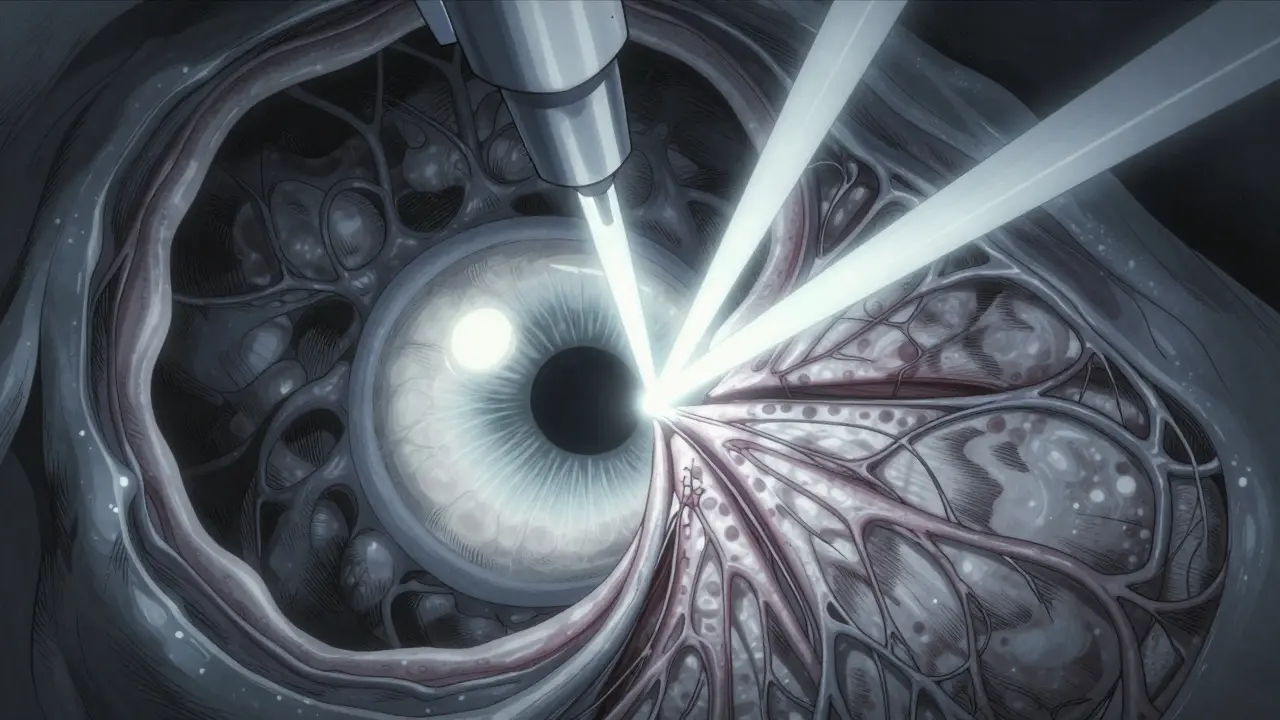
If you are tired of managing daily hardware, surgery is a permanent option. Refractive surgery reshapes the cornea itself. The most well-known procedure is LASIK (Laser-Assisted In Situ Keratomileusis), approved decades ago but constantly improving. It uses a femtosecond laser to create a flap and an excimer laser to reshape the underlying tissue. It takes minutes and allows most patients to return to work within a day.
A newer alternative gaining traction is SMILE (Small Incision Lenticule Extraction). Unlike LASIK, SMILE doesn't require lifting a corneal flap, which may reduce the risk of dry eyes, a common complaint affecting up to forty percent of post-LASIK patients initially. Another option is PRK, where the surface layer of cells is removed entirely. This heals slower but is often recommended for those with thinner corneas who aren't candidates for flap procedures. The precision of modern lasers now operates within margins of 0.25 diopters, meaning even minor prescriptions can be corrected accurately.
The Growing Concern of Myopia in Children
We used to think children growing their eyes meant growing their myopia. Today, we know it's often environmental. Spending excessive time indoors and focusing on close-up screens triggers biological signals for the eye to elongate. With fifty percent of the world's population potentially myopic by 2050, controlling progression is vital. Standard glasses just fix the focus; they don't stop the growth.
Specialised strategies are now emerging for parents worried about their kids' worsening prescriptions. Orthokeratology, or Ortho-K, involves rigid contact lenses worn overnight. They temporarily flatten the cornea, providing clear vision during the day without wearing anything. More importantly, studies suggest they slow down eye elongation. Another method involves low-dose atropine eye drops, a medication applied regularly to dilate the pupil slightly and signal the eye to stop stretching. These interventions are significant because highly myopic eyes carry five to ten times the risk of retinal detachment later in life compared to emmetropic eyes.
Living with Your Correction Plan
Once you decide on a path, adaptation is key. A new prescription for astigmatism can feel weird initially. The floor might look curved, or walking uphill might feel steeper. This usually settles within two weeks as your brain rewires to process the corrected visual data. Don't panic if it feels strange; give it time. Regular check-ups are essential not just for updating numbers, but for monitoring the health of the retina, especially if you have a high prescription.
Can refractive errors be cured completely?
Glasses and contacts manage the condition temporarily, meaning they correct the symptom. Laser surgery physically changes the shape of the cornea to eliminate the dependency on glasses, which is considered a functional cure for the refractive error, though the underlying tendency remains genetic.
Why does my vision fluctuate throughout the day?
Fatigue and dehydration affect tear film quality and muscle tension. Dry eyes often cause temporary blurring, while prolonged screen time forces accommodation muscles to spasm, temporarily mimicking a higher prescription strength.
Is LASIK safe for everyone?
No. You need a stable prescription for at least twelve months, adequate corneal thickness (minimum 500 microns), and no autoimmune diseases. People with unstable conditions like progressive retinopathy are generally excluded from surgery.
How often should I update my prescription?
Adults should review their vision annually. Children with myopia may need updates every six months during growth spurts to ensure proper control of progression.
What indicates I need surgery rather than glasses?
Surgery is elective based on convenience and cost preference. If you are frustrated by glasses smudging or find contacts inconvenient, and your metrics allow, surgery provides a permanent solution. It does not improve vision beyond 20/20, so expectations must be realistic.
Harrison Duncombe
I have been working in the pharmaceuticals industry for over two decades and have developed a passion for medications and their impact on health. I enjoy researching new treatments and writing about their effects on diseases. Sharing my knowledge about supplements is something I find fulfilling. Through my work, I aim to provide valuable insights and guidance to those seeking understanding in this complex field.
Honestly, most adults refuse to acknowledge that blurry vision isn't just a nuisance but a genuine optical failure. Society has become so accustomed to squinting that fixing the root cause feels trivial to many. The mechanics of light refraction are basic physics yet ignored by the average consumer. You see people buying prescription sunglasses without even knowing their diopter measurement. This apathy toward eye health extends to children who spend all day indoors staring at screens. Parents often blame genetics exclusively while ignoring environmental factors driving elongation. A diet high in sugar and low in greens affects the axial length of the eye directly. Modern architecture lacks sufficient daylight exposure which triggers biological growth signals negatively. Optical clinics market contacts aggressively without mentioning the keratitis risks involved. Hygiene compliance is statistically low among teenage wearers despite warnings. Surgical interventions remain stigmatized due to outdated myths about safety thresholds. Femtosecond lasers offer precision that older excimer models simply could not achieve. Dry eye syndrome is dismissed as temporary when it can persist for years after surgery. Regulatory bodies should enforce stricter monitoring on myopia control methods for minors. We need a cultural shift towards viewing vision preservation as essential maintenance. Continuing to normalize blur is doing a disservice to public health initiatives globally.
This guide makes me feel so much more optimistic about finding clear vision soon! 😊
good points on cornea shape :) i liked the bit about cameras too
This is unacceptable behavior when it comes to our children's health 🤷♀️ We allow our kids to rot in front of devices while claiming ignorance about eye damage. It is a moral failing of modern parenting to prioritize convenience over biological well-being 😠. The stats on myopia progression are scary enough to warrant immediate action. Every parent reading this needs to restrict screen time starting today. You cannot just put on stronger glasses every year and call it progress. There is a direct link between indoor lifestyles and worsening prescriptions. We owe it to the next generation to demand better outdoor policies. Schools need to enforce recess times outside regardless of weather conditions. This negligence puts their long term health at risk unnecessarily. Stop making excuses and fix the environment 🛑.
The data presented here suggests that LASIK remains the gold standard despite emerging alternatives. SMILE procedures appear superior regarding flap complications but require higher surgeon skill sets. Cost analysis clearly favors glasses for short term budget planning. However long term quality of life adjustments heavily weigh in favor of permanent correction. The risk matrix for microbial keratitis in contact lens wearers is substantial. One must weigh the convenience against the infection probability rigorously. Patient selection criteria are often overlooked in mainstream marketing campaigns. We see patients rushing into surgery without stabilizing prescriptions fully. Medical ethics should demand longer waiting periods for candidates showing fluctuations. The economic burden of recurrent dry eye treatment is significant.
Vision acts as a portal to reality yet we obscure it with glass constantly. The dance of photons entering our retinas defines how we experience existence itself. Blurred edges suggest a world trying to reveal its true shape to us. Perhaps clarity is not always the goal but the journey of seeing differently matters most. Our eyes are instruments tuned to survive but not necessarily to love beauty. Correcting the lens might sharpen the image but does not deepen the insight gained. Technology fixes the hardware yet ignores the software running inside our heads. We chase 20/20 acuity while losing appreciation for the spectrum of focus available.
Big Pharma and lens companies want us to stay dependent forever 🙄 Why else push glasses before offering cures openly? They know the cure exists yet they keep selling us monthly subscriptions. The whole industry benefits from perpetual visual decline worldwide 🏴☠️. Myopia rates skyrocketing proves the current model is unsustainable. Wake up before they decide to charge for clean air next 👁️.
ur so right about the screen time thing tho i get worried u push too hard on parents 🥺 sometimes balance is key we dont want kids stressed either. i think small steps work best like more walks outside. hope everyone finds what works for them ❤️