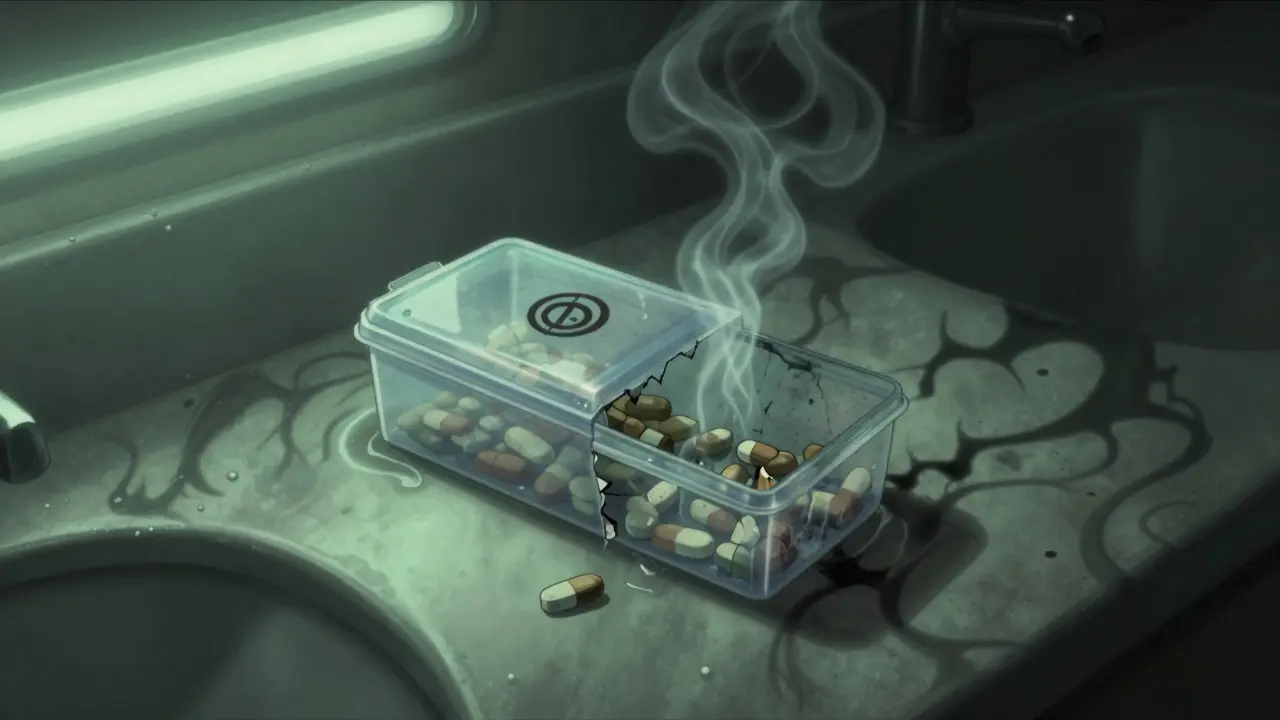
When you pick up a prescription from the pharmacy, you might assume the expiration date on the bottle is set in stone. But if your medication was moved from its original container into a pillbox or a smaller vial, that date might be wrong-and dangerously so. Repackaged medications, whether in weekly organizers or pharmacy-labeled vials, don’t automatically inherit the manufacturer’s expiration date. In fact, studies show that repackaged medications can degrade faster than those left in their original packaging, leading to reduced effectiveness or even harmful breakdown products. This isn’t a minor detail. It’s a patient safety issue backed by federal warnings, peer-reviewed science, and real-world pharmacy failures.
Why Repackaging Changes Everything
The original container a drug comes in isn’t just for convenience. It’s part of the drug’s design. Manufacturers test their medications inside specific packaging-like HDPE bottles with desiccants, amber glass to block light, or sealed blister packs that limit air exposure. When a pharmacist transfers pills into a plastic vial or a plastic pillbox, those protective barriers are gone. Suddenly, moisture, oxygen, and light can get in. And that’s where stability problems begin.A 2019 study in the Journal of Pharmaceutical Sciences found that albuterol sulfate tablets stored in standard pharmacy vials lost 15.7% of their potency after just 90 days. In the original manufacturer’s bottle with a desiccant, degradation was only 3.2%. That’s more than four times worse. The reason? Moisture vapor transmission rates in pharmacy vials are often 0.35-0.50 g/m²/day. The original bottles? Around 0.10-0.25 g/m²/day. That difference matters when you’re dealing with drugs that break down in humid air-like amoxicillin, which can become ineffective or even toxic when exposed to moisture.
What Degradation Looks Like
Stability isn’t just about whether a pill still works. It’s about whether it’s safe. Degradation can happen in several ways:- Hydrolysis: Water breaks chemical bonds. Drugs like aspirin, penicillin, and insulin degrade this way. Even a little moisture in a pillbox can trigger it.
- Oxidation: Oxygen reacts with active ingredients. Nifedipine, a blood pressure drug, turns brown and loses potency when exposed to air.
- Photodegradation: Light breaks down molecules. Drugs like warfarin, riboflavin, and chlorpromazine are sensitive to UV light. Clear pillboxes? Big problem.
- Physical changes: Pills stick together, change color, or crumble. This isn’t just cosmetic-it signals chemical breakdown.
The FDA’s 2023 warning letter to a major pharmacy chain cited failure to assign proper expiration dates for repackaged drugs as a critical violation-so serious it shut down their repackaging operations for 45 days. That’s not a footnote. It’s a red flag.
How Long Do Repackaged Medications Really Last?
There’s no one-size-fits-all answer. But here’s what the data shows:- 30 days: For hygroscopic drugs like amoxicillin, doxycycline, and certain antibiotics. These absorb moisture like a sponge. Even with desiccants, 30 days is the max.
- 60 days: For light-sensitive drugs like nifedipine, nitroglycerin, and isotretinoin. Amber vials help, but they’re not perfect.
- 90 days: For stable, non-hygroscopic drugs like atenolol, metformin, and lisinopril. Even then, only if stored in cool, dry conditions.
- 6 months: The upper limit recommended by the International Pharmaceutical Federation (FIP) for solid oral dosage forms under standard pharmacy storage. Anything longer requires formal testing.
And here’s the kicker: 82% of U.S. states have rules limiting repackaged meds to 6 months or less. Seventeen states cap it at 30-90 days for certain drugs. The FDA doesn’t let pharmacies use the original expiration date unless the drug stays in its original container with its original desiccant and seal. If it’s been moved? You’re on your own.
What About Pillbox Medications?
Pillboxes are the biggest stability wild card. Why? Because they combine multiple drugs from different manufacturers-each with different packaging needs-into one container. That’s a recipe for trouble.A 2022 study from the American Pharmacists Association found that 18.7% of pillbox combinations showed physical interactions within 14 days. Pills stuck together. Colors changed. Some even dissolved into a gooey mess. Why? Because one drug might be releasing moisture, another might be absorbing it. A calcium supplement might raise the humidity inside the box. A beta-blocker might react with an antacid. No one tested this combo before you started using it.
And the problem isn’t just chemical. It’s physical. If your pillbox has a snap-on lid, it’s not sealed. Air gets in. Moisture gets in. Light gets in. And if you’re storing it on your bathroom counter? Temperature and humidity swings every day. That’s not storage-that’s a degradation lab.
How to Evaluate Stability-Practical Steps
You don’t need a lab to start evaluating stability. Here’s how to do it right:- Check the original packaging. If the drug came with a desiccant, keep one in the repackaged container. Desiccant packs extend stability by up to 47%, according to ISMP’s 2023 trial.
- Use amber containers for light-sensitive drugs. If you’re repackaging nifedipine, warfarin, or riboflavin, don’t use clear plastic. Use amber vials or wrap the pillbox in aluminum foil.
- Store in a cool, dry place. Not the bathroom. Not the kitchen counter. A bedroom drawer or cabinet away from windows is ideal. Temperature should stay under 25°C (77°F). Humidity below 60%.
- Watch for changes. Look for discoloration, crumbling, sticking, or odd smells. If a pill looks different, don’t take it. That’s not “just old”-that’s degraded.
- Assign a new expiration date. Use the shortest of: the manufacturer’s date, 6 months from repackaging, or state law limits. For high-risk drugs (like warfarin, digoxin, or seizure meds), go with 30 days unless you have test data.
What Pharmacies Should Be Doing
Pharmacies that repack medications should have written protocols. The ASHP recommends a tiered approach:- High-risk drugs: Use HPLC testing to measure degradation before assigning an expiration date. This is required for chemotherapy, biologics, and narrow-therapeutic-index drugs.
- Low-risk drugs: Use bracketing-grouping similar drugs (e.g., all beta-blockers) and testing one representative. If one holds up, others likely do too.
- Stress testing: Expose samples to 40°C and 75% humidity for 14 days. If the drug degrades under those conditions, it won’t last 30 days in normal storage.
Unfortunately, only 28% of independent pharmacies have access to HPLC equipment. That means most rely on conservative estimates-and that’s okay. Better to be safe than sorry.
The Bottom Line
Repackaged medications aren’t inherently unsafe. But treating them like they’re the same as the original? That’s where the risk lies. The FDA, USP, and ASHP all agree: expiration dates don’t transfer. Stability must be evaluated. And for most patients, that means assuming 30-90 days max unless you have proof otherwise.If you’re using a pillbox, check for color changes. Keep it away from heat and moisture. Don’t assume your pharmacist’s expiration date is scientific-it might just be a guess. And if you’re unsure? Call your pharmacist. Ask: “Was this tested? How long is it really good for?”
Medication safety isn’t about labels. It’s about science. And science says: if it’s been moved, it’s not the same.
Can I use the manufacturer’s expiration date on repackaged medications?
No. The FDA explicitly states that the original expiration date only applies if the medication remains in its original container with its original desiccant and closure system. Once a drug is repackaged, the expiration date must be reassessed based on stability testing or conservative guidelines. Using the original date is a violation of federal regulations.
How long can I safely store repackaged pills in a pillbox?
For most solid oral medications, 30 to 90 days is the safe window. Hygroscopic drugs like antibiotics should be used within 30 days. Light-sensitive drugs like nifedipine should be stored in amber containers and used within 60 days. Stable drugs like atenolol or metformin may last up to 90 days if stored properly. Beyond that, degradation becomes likely. Never exceed 6 months.
Do desiccant packs really help with stability?
Yes. A multicenter trial by the Institute for Safe Medication Practices showed that adding desiccant packs to repackaged containers extended stability by 47% across 8,432 units. For moisture-sensitive drugs like amoxicillin or doxycycline, a desiccant is not optional-it’s essential.
What should I do if my pills look different in the pillbox?
Don’t take them. Discoloration, sticking, crumbling, or unusual odors are signs of chemical degradation. Even if the pills look fine, they may have lost potency. Contact your pharmacist immediately. Replace the medication and ask for a new batch with a fresh expiration date.
Are there any drugs that should never be repackaged?
Yes. Biologics, insulin, nitroglycerin, and chemotherapy drugs should never be repackaged outside of a licensed compounding facility. These drugs are extremely sensitive to environmental changes and require specialized storage. Repackaging them in a standard pillbox or vial can lead to dangerous loss of potency or contamination.
How can I find out the stability profile of my medication?
The University of Florida’s Web-based Stability Database, launched in January 2023, provides evidence-based expiration dates for over 1,800 repackaged medication scenarios. Many hospital pharmacies now use this resource. Ask your pharmacist if they consult this database or similar tools. If they don’t, request that they do.

Arlen Whitlock
My name is Arlen Whitlock, and I am an expert in the field of pharmaceuticals. With a deep passion for understanding medications and their effects on various diseases, I have dedicated my life to researching and developing innovative drug therapies. I also have a keen interest in dietary supplements and their potential interactions with medication. Sharing my knowledge and insights with others is one of my greatest passions, and I fulfill this by writing about the latest advancements in medication, the treatment of various diseases, and the role of supplements in health. Through my work, I hope to contribute to the betterment of public health and the well-being of patients around the world.