Every time you pick up a generic pill, you’re trusting that it’s exactly what the label says. No extra ingredients. No missing active drug. No dangerous contaminants. But how do we know it’s real? The answer isn’t in the packaging or the price-it’s in the quality control built into every step of manufacturing.
Why Quality Control Isn’t Just a Checklist
A counterfeit drug doesn’t always look fake. Sometimes it looks identical. It has the same color, shape, and imprint. But inside, it might contain too little active ingredient-or none at all. Or worse, it could have toxic chemicals like diethylene glycol, the substance behind the 1937 sulfanilamide tragedy that killed 107 people. That’s why quality control isn’t about testing the final product. It’s about building safety into every part of the process. The FDA calls this principle: "Quality cannot be tested into a finished product; it must be built into the design and manufacturing process at every single step." This isn’t a slogan. It’s the foundation of Current Good Manufacturing Practices, or cGMP (21 CFR Part 211). These rules apply equally to brand-name drugs and generics. A generic drug isn’t a cheaper version-it’s a legally required copy that must perform the same way as the original.The SQUIPP Framework: What Makes a Generic Drug Reliable
Generic manufacturers don’t just guess what works. They follow the SQUIPP framework: Safety, Quality, Identity, Potency, and Purity. Each letter represents a non-negotiable standard.- Identity: Every batch of raw material is tested using infrared spectroscopy and high-performance liquid chromatography. These tools can detect if a chemical looks right but behaves wrong-like a fake diamond that passes a scratch test but fails under laser analysis.
- Potency: The drug must contain between 90% and 110% of the labeled amount of active ingredient. Too little? It won’t work. Too much? It could be dangerous.
- Purity: Contaminants like heavy metals, residual solvents, or microbial growth are strictly limited. Even tiny amounts of impurities can cause serious side effects.
- Quality: The drug must dissolve properly in the body. Dissolution testing ensures the pill releases its drug within 30 to 45 minutes, just like the brand-name version.
- Safety: This includes environmental controls. Clean rooms must meet ISO Class 5 standards-fewer than 3,520 airborne particles per cubic meter. That’s stricter than many hospital operating rooms.
How Digital Systems Stop Counterfeits Before They Ship
Physical testing alone isn’t enough. Counterfeiters are getting smarter. That’s why the industry uses digital fingerprints. The Drug Supply Chain Security Act (DSCSA) requires every package of medicine to have a unique serial number. Think of it like a license plate for your pill bottle. When a pharmacy receives a shipment, it scans each unit. If the number doesn’t match what the manufacturer sent, the system flags it immediately. By 2023, 92% of top generic manufacturers had implemented this system. Behind the scenes, Electronic Quality Management Systems (eQMS) track over 15,000 data points per batch. These cloud-based platforms monitor everything: temperature during storage, humidity in the lab, even the operator’s ID when they run a test. If a value goes outside the allowed range, the system halts production. One quality manager at Teva told Reddit that after implementing their eQMS, they cut deviation resolution time from 14 days to just 48 hours.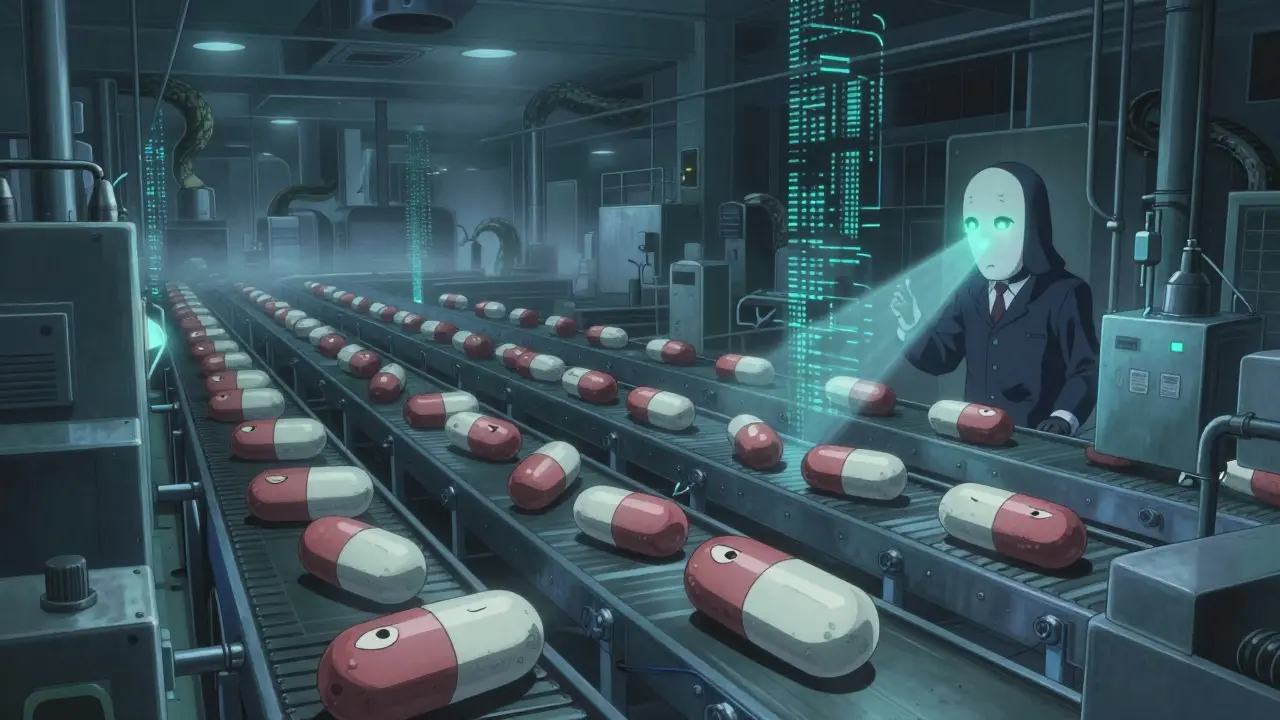
Why Some Counterfeits Still Slip Through
Even with all these systems, there’s a blind spot: polymorphs. A drug molecule can arrange itself in different crystal forms-called polymorphs. Only one form is therapeutically effective. Counterfeiters can replicate the chemical formula perfectly but use the wrong crystal structure. The pill looks fine. The chemical test says it’s good. But the body can’t absorb it. That’s what happened in 2018 with valsartan, a blood pressure drug. A change in the manufacturing process created a carcinogenic impurity that standard tests didn’t catch. The FDA recalled millions of pills. This isn’t a failure of regulation-it’s proof that quality control must evolve. The European Medicines Agency requires a Qualified Person (QP) to personally review and sign off on every batch before release. The U.S. system relies more on process validation. Both work-but the QP system adds a human layer of accountability that’s harder to fake.Global Gaps and the Cost of Compliance
In the U.S., 94% of generic drug facilities pass FDA inspections. But that number drops sharply overseas. In India, only 78% pass. In China, it’s 65%. That’s why the FDA sends inspectors abroad-and why nearly half of all counterfeit drugs seized globally come from these regions. The cost of compliance is real. Installing a full eQMS system can run $2 million to $5 million. A single mass spectrometer for identity testing costs $500,000 to $1 million. Small manufacturers struggle to keep up. But the alternative is worse: a single counterfeit incident can wipe out a company’s reputation-and cost lives.
The Future: AI, Blockchain, and Molecular Taggants
The next wave of defense is already here. AI-powered systems are being trained to spot subtle anomalies in production data before they become problems. IBM and Siemens have invested over $1.2 billion in AI for pharma quality control. In Africa, the WHO is testing blockchain-based verification for antimalarial generics. Each package gets a digital ledger entry that patients can scan with their phones. If the chain is broken, the drug is flagged. By 2026, the EU will require quantum-resistant cryptography on all drug packaging. And researchers are developing molecular taggants-tiny, invisible markers embedded in the drug itself. These can be read with handheld devices, making it nearly impossible to replicate.What You Can Do
As a patient, you can’t inspect a pill’s manufacturing history. But you can choose where you buy. Buy from licensed pharmacies. Avoid websites that sell drugs without a prescription. The FDA found that 96% of drugs from unregulated online pharmacies failed quality tests. If your generic drug looks different than usual, ask your pharmacist. It might be a different manufacturer-but it should still meet the same standards. And if you suspect a counterfeit, report it to the FDA’s MedWatch program.Final Reality Check
Generic drugs make up 90% of prescriptions in the U.S. but only 23% of spending. That’s because they work. And they’re safe-not because they’re cheap, but because they’re held to the same gold standard as brand-name drugs. The system isn’t perfect. But it’s built on science, not luck. And every time a counterfeit pill is caught before it leaves the factory, it’s because someone followed the rules. Not because they were scared. But because they knew what was at stake.
Arlen Whitlock
My name is Arlen Whitlock, and I am an expert in the field of pharmaceuticals. With a deep passion for understanding medications and their effects on various diseases, I have dedicated my life to researching and developing innovative drug therapies. I also have a keen interest in dietary supplements and their potential interactions with medication. Sharing my knowledge and insights with others is one of my greatest passions, and I fulfill this by writing about the latest advancements in medication, the treatment of various diseases, and the role of supplements in health. Through my work, I hope to contribute to the betterment of public health and the well-being of patients around the world.
I just took my generic blood pressure med this morning and thought about this post. I mean, really-how do we know it’s not secretly filled with rat poison? I’ve seen the news. People die. And yet we just swallow it like it’s candy. Someone’s gotta be watching, right? Or are we just gambling with our lives now? 😔
The FDA doesn’t inspect 90% of foreign facilities. That’s not regulation. That’s a fantasy.
We outspend China and India on compliance by 300%. Their 'quality control' is a suggestion. We enforce. That’s why American generics are the gold standard.
In India, we take immense pride in our pharmaceutical industry. The regulatory framework is robust, and compliance is not optional-it is a cultural commitment to global health. Many of our facilities exceed international standards.
i didnt know about polymorphs?? like the crystal thing? wow. so if the pill looks right but the atoms are arranged wrong?? it just... doesnt work?? like a broken key that fits the lock but wont turn??
I’ve been on generics for 12 years. Never had an issue. But reading this? I get it now. It’s not luck. It’s science. And the people who work in those clean rooms? They’re heroes. Quiet ones. But heroes.
AI in pharma? YES PLEASE! 🙌 I mean, imagine a machine catching a bad batch before it even leaves the lab. That’s next-level stuff. We’re not just curing diseases-we’re building trust, one pill at a time.
The implementation of eQMS systems has dramatically improved batch traceability and deviation response times. This is not merely technological advancement-it is a paradigm shift in pharmaceutical accountability. Every data point matters.
I used to be scared of generics. Now I get them because they’re cheaper. But after reading this? I get them because they’re safe. And that’s all that matters. 🙏
The claim that 94% of U.S. facilities pass inspections is statistically misleading. The FDA conducts pre-announced inspections. Facilities have 72 hours to clean up. This is theater, not oversight.
I just found out my pharmacy switched my generic and now the pill looks different and I freaked out for like 3 days and called my doctor 4 times and cried and then found out its totally fine but like WHY DO THEY DO THIS TO US
You think this is safe? Wait until a batch slips through and 50 people die. Then you’ll see how fast the FDA changes its tune.
I love that they’re using blockchain in Africa. It’s so simple, but so powerful. Patients can verify their own medicine. That’s dignity. That’s power.
The QP system in Europe is a facade. The person signing off is often underpaid, overworked, and pressured by management. This is not accountability. This is ritual. And it is failing