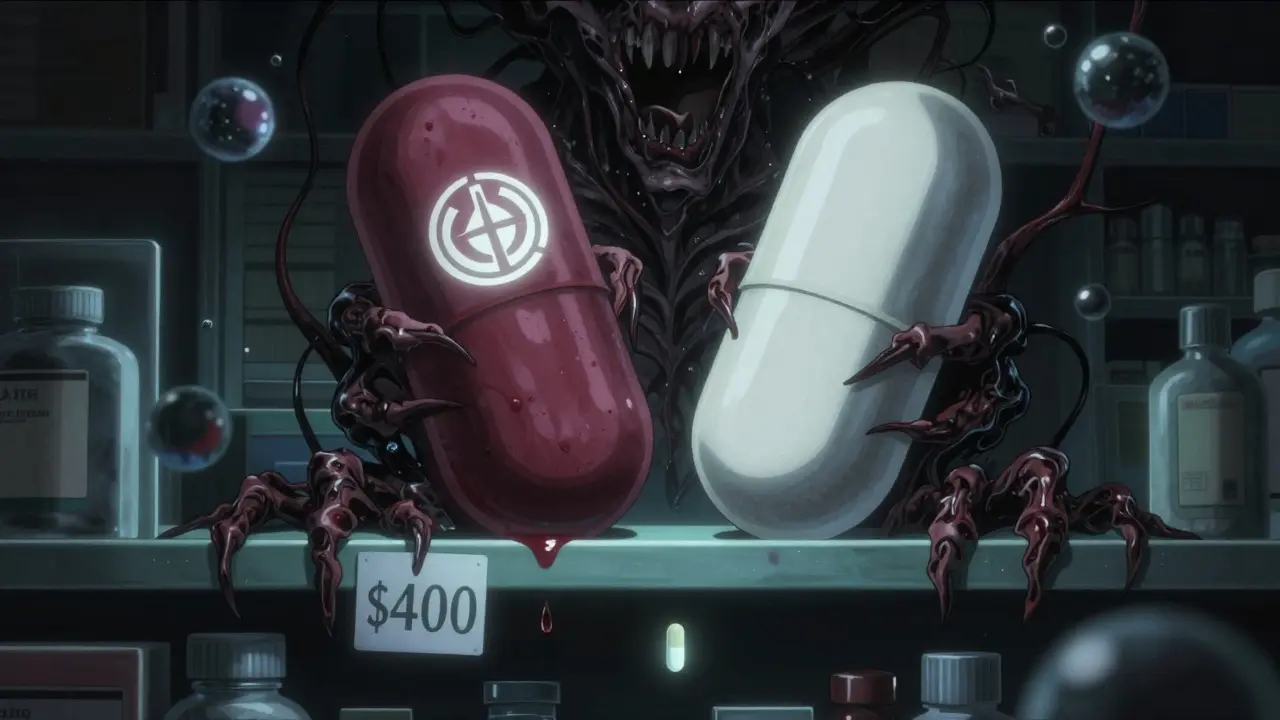
When you pick up a prescription, you might see two pills that look completely different-one is a big blue capsule with a fancy name, the other is a small white tablet with no logo. One costs $4. The other costs $400. You might wonder: Are they really the same?
They contain the exact same active ingredient
The short answer is yes. Generic drugs and brand-name drugs contain the same active ingredient, in the same strength, and delivered the same way-whether it’s a pill, injection, or inhaler. That’s not a guess. It’s a legal requirement enforced by the U.S. Food and Drug Administration (FDA). If a generic drug didn’t have the exact same active ingredient as the brand-name version, it wouldn’t be allowed on the market.Take metformin, for example. The brand-name version is called Glucophage. The generic is just metformin. Both contain the same molecule: 1,1-dimethylbiguanide. Both work the same way to lower blood sugar in people with type 2 diabetes. The same goes for amlodipine (Norvasc), sertraline (Zoloft), or lisinopril (Zestril). The active ingredient doesn’t change. What changes is the price-and sometimes the color.
How do we know they work the same?
It’s not enough to say the ingredients are the same. You need proof that the body absorbs them the same way. That’s where bioequivalence comes in.The FDA requires generic manufacturers to prove their drug delivers the same amount of active ingredient into the bloodstream at the same rate as the brand-name version. This is measured using two key numbers: Cmax (the highest concentration in the blood) and AUC (how much of the drug is absorbed over time). The generic’s results must fall within 80% to 125% of the brand-name drug’s numbers. That’s a tight range. It means the generic won’t be too weak or too strong.
Over 3.5 million patient records were analyzed in a landmark 2019 study published in JAMA Internal Medicine. Researchers looked at generics for diabetes, high blood pressure, depression, and osteoporosis. The results? No meaningful difference in outcomes. People taking generic glipizide had the same HbA1c levels as those on Glucophage. Those on generic amlodipine had the same blood pressure control as those on Norvasc. The same was true for antidepressants and bone meds.
Why are generics so much cheaper?
Brand-name drugs cost a lot because the company that invented them had to pay for years of research, clinical trials, and marketing. That’s expensive. The FDA requires those trials to prove safety and effectiveness before a drug can be sold. Once the patent expires-usually after 20 years-the door opens for other companies to make copies.Generic manufacturers don’t have to repeat those expensive trials. They just need to prove bioequivalence. That cuts their costs dramatically. They also don’t spend millions on TV ads or fancy packaging. That’s why a 30-day supply of generic metformin costs about $4, while the brand-name version can hit $350. Generic amlodipine? $2. Brand-name? $400. That’s not a typo.
According to the Generic Pharmaceutical Association, generics saved the U.S. healthcare system $313 billion in 2022 alone. Over the last decade, that total hit $2.2 trillion. That’s money saved on insurance premiums, out-of-pocket costs, and hospital visits because people could actually afford their meds.
What’s different about generics?
The only parts that change are the inactive ingredients-the fillers, dyes, binders, and coatings that hold the pill together or make it look different. These make up about 90% of the pill’s weight but have no effect on how the drug works.That’s why a generic version of a drug might be a different color, shape, or size. It’s not trying to trick you. It’s because the brand-name company owns the trademark on how their pill looks. So generic makers have to make theirs look different.
For most people, this doesn’t matter. But for some, especially those taking multiple pills, it can cause confusion. A 72-year-old woman on seven medications might see her blood pressure pill suddenly turn from blue to white and think it’s the wrong drug. That’s why pharmacists are trained to explain the switch.
Occasionally, someone reports side effects after switching to a generic-like stomach upset or dizziness. In rare cases, this might be linked to an inactive ingredient. For example, someone allergic to a dye in the generic version might get a rash. But these reactions are extremely uncommon-about 0.05% of switches, according to FDA data.
Are there exceptions?
Yes. A small group of drugs called narrow therapeutic index (NTI) drugs need extra care. These are medications where even a tiny change in blood levels can cause problems. Examples include warfarin (blood thinner), levothyroxine (thyroid hormone), and some seizure meds like phenytoin.For these, the FDA still requires the same 80%-125% bioequivalence range. But doctors and pharmacists often recommend sticking with one version-brand or generic-once you’ve found what works. Switching back and forth isn’t dangerous, but it’s not always necessary. If you’re stable on a brand-name version, your doctor might keep you on it. But if cost is an issue, switching to a generic is still considered safe and effective.
Who approves generics?
The same agency that approves brand-name drugs: the FDA. All drug factories-whether making brand-name or generic pills-must meet the same strict standards called Current Good Manufacturing Practices (cGMP). The FDA inspects over 3,500 facilities each year, including factories in the U.S., India, and China. A 2022 report showed that less than 0.5% of generic production was affected by import alerts due to quality issues. That’s a tiny fraction.Every generic drug gets an “A” rating in the FDA’s Orange Book, meaning it’s rated as therapeutically equivalent to the brand-name drug. You can look up any drug on the FDA’s Drugs@FDA database and see its rating. No mystery. No guesswork.
What do real patients say?
A 2023 survey by GoodRx of 5,000 people found that 87% noticed no difference between their generic and brand-name drugs. Most said they felt the same, had the same side effects, and saw the same results.On Reddit, users shared stories like: “Switched from Zoloft to generic sertraline and saved $280/month. No change in mood or anxiety.” Or: “My blood pressure hasn’t budged since I switched to generic amlodipine. Best decision ever.”
But some people did report changes. One user wrote: “Generic sertraline gave me stomach issues that Zoloft never did.” That’s not common-but it happens. In those cases, going back to the brand or trying a different generic often fixes it.
Kaiser Permanente’s patient satisfaction data shows 92% of members were happy with generics. The main reason? Affordability. People who couldn’t afford their meds before could now take them consistently. That led to 15% better outcomes for chronic conditions like diabetes and high blood pressure.
Can your pharmacist switch your drug without asking?
In 49 U.S. states, yes. Pharmacists can substitute a generic for a brand-name drug unless the doctor writes “dispense as written” or “no substitution.” This is legal and standard practice. Insurance companies often require it. If you’re on Humana, for example, 92% of brand-name requests are automatically switched to generics unless there’s a medical reason not to.If you’re unsure, ask your pharmacist. They can explain why the pill looks different and confirm it’s the right drug. Most people understand after a two-minute explanation. UC Health Net found 95% of patients got it right after a quick chat.
What’s changing in 2026?
More drugs are losing patent protection. Big-name drugs like Eliquis and Stelara-each worth billions in annual sales-are now opening up to generic competition. The FDA is speeding up approvals under its new GDUFA III program, aiming to cut approval times from 18 months to under 10. That means more generics, faster.At the same time, the FDA is focusing on complex drugs-like inhalers, nasal sprays, and topical creams-that are harder to copy. These are the next frontier for generics. By 2028, experts predict 95% of all prescriptions will be filled with generics.
Bottom line: You’re not getting less medicine
Generic drugs aren’t cheaper because they’re worse. They’re cheaper because they don’t carry the cost of invention, marketing, and patent protection. The active ingredient is identical. The way your body uses it is identical. The clinical results are identical.If you’re worried about switching, talk to your doctor or pharmacist. But don’t let the color or the price fool you. A white pill isn’t a lesser version of a blue one. It’s the same medicine, at a fraction of the cost. And for millions of people, that difference in price is the difference between taking their medicine-and not.

Harrison Duncombe
I have been working in the pharmaceuticals industry for over two decades and have developed a passion for medications and their impact on health. I enjoy researching new treatments and writing about their effects on diseases. Sharing my knowledge about supplements is something I find fulfilling. Through my work, I aim to provide valuable insights and guidance to those seeking understanding in this complex field.
My pharmacist switched my antidepressant to generic last month. I cried for three days thinking I was losing my mind. Turns out? I was just crying over a white pill.
So let me get this straight. You're saying a pill made in a factory in India with no marketing budget is just as good as one made in a lab with a 100 million dollar ad campaign? That's not science. That's capitalism pretending to be medicine.
generic drugs are legit bro i switched from zoloft to sertraline and saved 300 bucks a month no difference at all my dog even noticed i was less moody
It is of paramount importance to recognize that the pharmacokinetic parameters of bioequivalence, while statistically robust, do not account for individualized physiological variance. The FDA's 80-125% range is a population-based metric, not a guarantee of therapeutic equivalence for the singular patient.
My uncle in Delhi takes generic blood pressure pills for 2 rupees a day. He’s 78. Still walks to the temple every morning. You think your $400 pill is making you live longer? Maybe it’s just making your wallet cry.
Of course they’re the same. The FDA is a regulatory body with a mandate to ensure access, not excellence. If you’re content with mediocrity disguised as affordability, then by all means, take the generic. But don’t pretend you’re not compromising.
just switched to generic metformin and honestly? i feel better because i’m not stressing about the cost. i used to skip doses. now i take it like clockwork. thanks for the info, this post helped me feel less guilty about saving money 💕
my grandma takes 7 pills a day. one week they all changed color. she called the pharmacy three times. now she just holds them up to the light and squints. we all do. it’s weird but we’re used to it.
Let me tell you something - in India, we don’t have the luxury of brand-name drugs. We’ve been taking generics since before your grandparents were born. If it works for a billion people, maybe your fear of white pills is just a symptom of privilege.
Okay, so the FDA says they’re equivalent. But have you ever looked at the manufacturing logs? The same factory that makes your generic metformin also makes the cheap antihistamine that gives people heart palpitations. The FDA doesn’t inspect every batch. They sample. And sometimes, the sample is lucky. What if your pill is the one they missed? You’re not just saving money - you’re gambling with your biology. And don’t tell me it’s ‘rare’ - rare doesn’t mean impossible. It just means it hasn’t happened to you yet.
Guys. This is the most important thing you’ll read this year. Generic drugs aren’t just cheaper - they’re a revolution. They let people keep their jobs, their homes, their lives. I used to work in a clinic where people chose between insulin and groceries. Now? They get both. Don’t let the color fool you - this is justice in pill form.
So the brand-name pill has a logo. The generic has a number. One tells you it’s premium. The other tells you it’s real. Which one is the lie? The one with the ad agency… or the one that just works?
The FDA’s 80-125% bioequivalence window is a regulatory loophole disguised as science. This is why American healthcare is broken - we’ve outsourced our pharmaceutical integrity to low-cost jurisdictions and called it innovation. If you think a pill made in a facility with a 0.5% import alert rate is ‘safe,’ you’re not informed - you’re naive.
people who take generics are just giving up on themselves. i know someone who switched to generic thyroid meds and now she’s always tired and crying. it’s not just the pill - it’s the mindset. you start believing you deserve the cheap version… and then you become it. 🙃