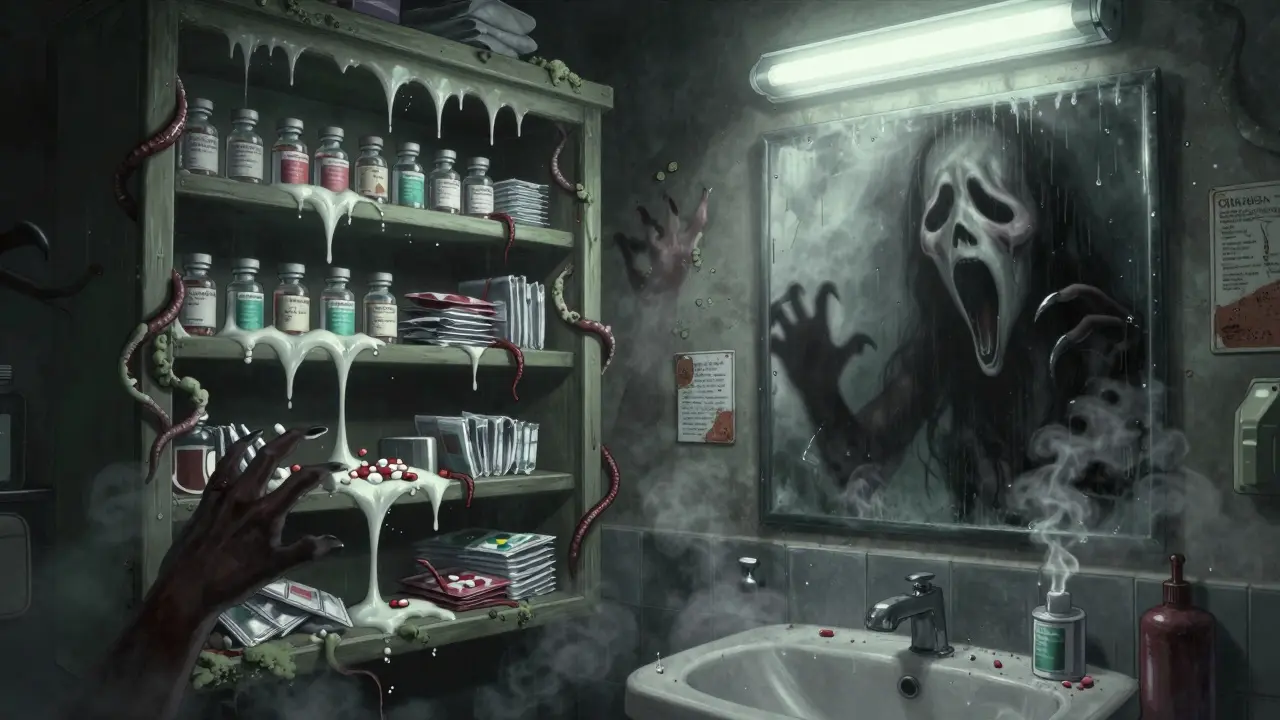
Most people keep their medications in the bathroom. It’s convenient - the medicine cabinet is right there, next to the toothbrush and soap. But here’s the truth: storing medications in the bathroom is one of the most common, and dangerous, mistakes people make with their prescriptions.
It’s not just about expired pills. It’s about whether your blood pressure medicine still works. Whether your insulin still lowers your sugar. Whether your antibiotics can actually kill the infection. And the bathroom? It’s the worst place in your house for all of them.
Why the Bathroom Is a Medication Killer
Bathrooms are hot, wet, and chaotic. Every time you take a shower, steam fills the air. Humidity levels spike to 80-100%. Temperatures can jump 20-30°F in minutes. That’s not just uncomfortable - it’s destructive to pills, patches, and liquids.
Medications are chemicals. And chemicals react to heat and moisture. Tablets absorb water and start to break down. Capsules get sticky or crack. Liquid medicines can separate. Insulin - a protein - becomes useless if it gets too warm. Nitroglycerin, used for heart attacks, loses its power in just weeks if exposed to humidity. Birth control pills? Studies show their effectiveness can drop by up to 35% when stored in damp, warm conditions.
The science is clear. Most medications need to be kept between 59°F and 77°F (15°C-25°C). That’s room temperature. Not steam room temperature. A 2021 study in the Journal of Diabetes Science and Technology found that blood glucose test strips - not even medications - gave wrong readings 68% of the time after being stored in a humid bathroom. If test strips fail, imagine what happens to real drugs.
What Happens When Medications Degrade
It’s not just about pills turning to dust. Degraded medications can be dangerous.
Take blood pressure drugs. A study published in Circulation showed that 30.2% of patients who stored their beta-blockers in the bathroom had inconsistent control of their blood pressure - not because their condition changed, but because the medicine didn’t work like it should. That’s not a coincidence. That’s chemistry.
Antibiotics are another big one. If they lose potency, they won’t kill the bacteria. Instead, they train the bacteria to survive. That’s how antibiotic resistance grows. The World Health Organization calls this one of the top global health threats. And it starts in your medicine cabinet.
Even over-the-counter drugs aren’t safe. Antihistamines that have degraded might not stop an allergic reaction. Anticoagulants like warfarin, if weakened, can cause dangerous clots. The Great Ormond Street Hospital in London reviewed pediatric medication errors and found that 4.3% were linked to degraded drugs stored in poor conditions.
The Hidden Danger: Access and Accidents
It’s not just about the medicine going bad. It’s about who can get to it.
Bathroom cabinets are rarely locked. Kids climb. Teens rummage. Pets jump up. The CDC says 70% of misused prescription opioids come from home medicine cabinets - and most of those are in bathrooms. The American Academy of Pediatrics says all medications should be stored in locked cabinets, out of reach. So why are we keeping them in the one place in the house that’s easiest to access?
And it’s not just kids. Visitors, house cleaners, even family members might grab a pill “just in case.” A nurse in Bristol told me she saw 42% of patients’ bathroom-stored meds showing visible signs of damage - crumbling, discolored, sticky - compared to only 8% stored properly. That’s not a guess. That’s observation.
Where You Should Store Medications Instead
Stop thinking about the bathroom. Start thinking about the bedroom.
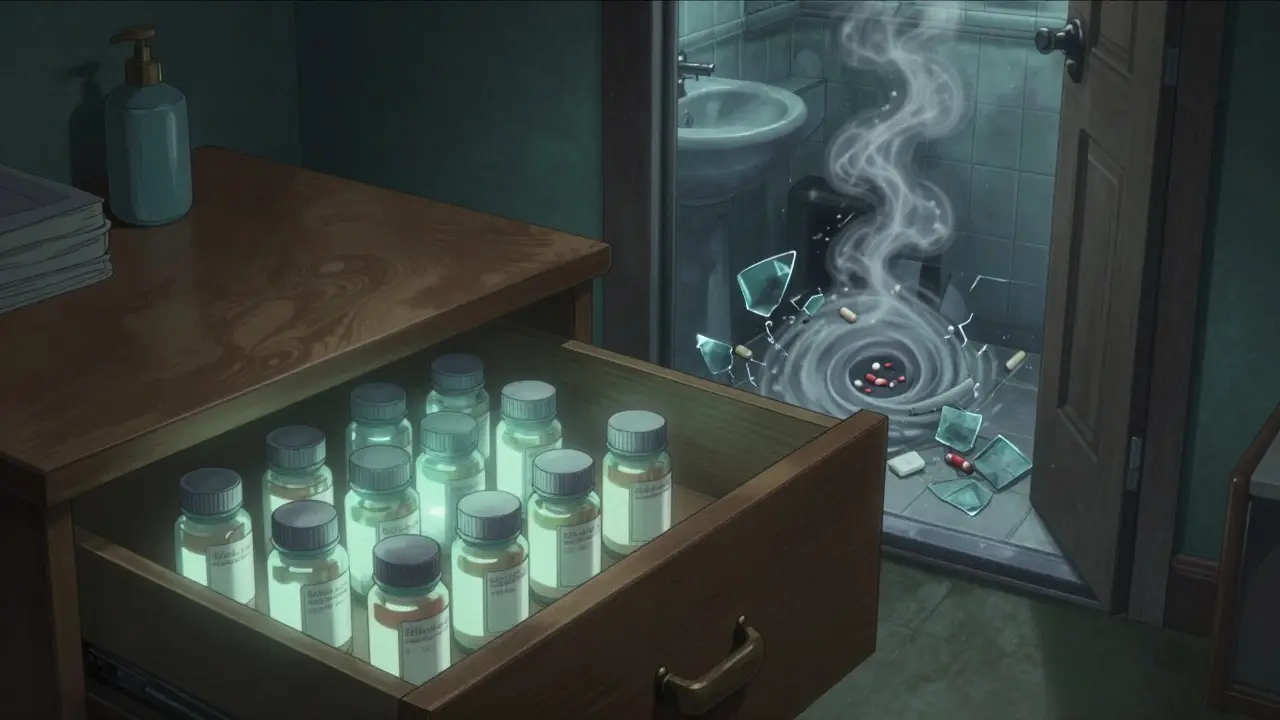
The best place? A cool, dry, dark spot. A drawer in your bedroom dresser. A closet shelf. A cabinet that doesn’t get sunlight or steam. Temperature changes there are tiny - maybe 2-3°F a day. In the bathroom? 15-20°F.
Keep medications in their original bottles. Those caps are designed to block moisture. Don’t dump them into plastic containers unless you’re using airtight, pharmaceutical-grade ones. And always keep the label with the name, dosage, and expiration date.
Some meds need refrigeration - insulin, certain eye drops, some antibiotics. But don’t put them in the fridge door. That’s where the temperature swings the most. Put them on a middle shelf, away from the freezer. And if you use a smart fridge? Don’t assume it’s safe. Most home fridges aren’t calibrated for medicine. Use a dedicated small fridge if you’re storing multiple refrigerated drugs.
What About Those “Smart” Medicine Cabinets?
Some companies now sell cabinets with humidity sensors, temperature alerts, and even locks. They’re great - if you can afford them. But you don’t need one.
Pharmaceutical companies are starting to include humidity-indicating strips inside pill bottles. If the strip turns color, the drug might be compromised. Thirty-two major drugmakers now use them. And in 2023, a study in the Journal of the American Pharmacists Association showed that using a medication app with storage reminders improved proper storage by 47%.
So if you don’t want to buy a new cabinet, just use your phone. Set a reminder: “Check where my meds are stored.” It takes 10 seconds. It could save your life.
What to Do With Old or Expired Medications
If your meds are old, discolored, or smell weird - throw them out. Don’t flush them. Don’t toss them in the trash where a kid or pet might find them. Don’t leave them in the bathroom to “see if they still work.”
Use a drug take-back program. Pharmacies in the UK, including those in Bristol, often have drop-off bins. The NHS runs periodic collection days. If there’s no program nearby, mix pills with coffee grounds or cat litter, seal them in a plastic bag, and put them in the trash. That makes them unappealing and hard to retrieve.
And clean out your medicine cabinet every three months. That’s the recommendation from Great Ormond Street Hospital. If you can’t remember when you last refilled something, it’s probably expired. Better safe than sorry.
Why This Still Happens
It’s not because people are careless. It’s because it’s always been this way.
Medicine cabinets became standard in bathrooms in the 1920s. Back then, pills didn’t degrade as fast. Modern drugs are more complex. More sensitive. But the habit stuck. A 2023 survey by First Databank found that 68% of Americans still store meds in the bathroom - even though 89% know it’s not ideal.
We’re stuck in old routines. We see the cabinet. We assume it’s meant for meds. But just because something’s always been there doesn’t mean it’s safe.
The fix is simple: move your meds. Just once. Do it today. Pick a drawer in your bedroom. Put them there. Lock it if you have kids or pets. Set a calendar reminder to check them every three months.
Your heart medicine. Your insulin. Your antibiotics. Your birth control. They’re not just pills. They’re your health. And they deserve better than steam and heat.
Can I store my medications in the kitchen?
The kitchen isn’t ideal either. Near the stove, oven, or sink means heat and moisture. Avoid countertops near the sink or window. If you must store meds in the kitchen, pick a high, cool cabinet away from appliances and sunlight. A pantry shelf is better than the counter, but still not as good as a bedroom drawer.
What if I have no closet or drawer in my bedroom?
Use a small, latched plastic storage box. Keep it on a shelf in your hallway, living room, or even under the bed. The key is keeping it away from heat, moisture, and light. A locked jewelry box works too - just make sure it’s not in a humid area like the bathroom or basement.
Do all medications degrade the same way in humidity?
No. Some are more sensitive than others. Insulin, nitroglycerin, birth control pills, and antibiotics are especially vulnerable. Liquid suspensions and patches also break down faster than solid tablets. Always check the label. If it says “store at room temperature,” that means 59-77°F, away from moisture. If it says “refrigerate,” keep it cold - but not frozen.
Is it safe to store medications in the car?
Absolutely not. Cars get extremely hot in summer - over 120°F on a sunny day. Even in winter, temperatures can drop below freezing. Medications exposed to those extremes can become ineffective or even toxic. Never leave pills in your glove box or console.
How do I know if my medication has gone bad?
Look for changes: tablets that crumble, change color, or have spots; capsules that stick together or leak; liquids that become cloudy or develop particles; patches that lose their stickiness. If you smell something odd - like vinegar or rot - throw it out. When in doubt, ask your pharmacist. They can tell you if a drug is still safe based on its appearance and storage history.
What if I’m traveling and can’t keep my meds in a cool place?
Use a small insulated pouch with a cold pack if you’re carrying insulin or other temperature-sensitive drugs. For others, keep them in your carry-on, not checked luggage. Avoid leaving them in hotel bathrooms. Use a small container in your suitcase, away from windows or heat sources. Most hotels have mini-fridges - ask if you can use one.

Harrison Duncombe
I have been working in the pharmaceuticals industry for over two decades and have developed a passion for medications and their impact on health. I enjoy researching new treatments and writing about their effects on diseases. Sharing my knowledge about supplements is something I find fulfilling. Through my work, I aim to provide valuable insights and guidance to those seeking understanding in this complex field.
I never thought about this but my mom keeps all her pills in the bathroom and she's been having weird blood pressure spikes lately. Maybe this is why. Time to move them.
This is real. My grandma’s insulin went bad in the bathroom. She almost ended up in the ER.
I used to keep my anxiety meds in the bathroom cause it was convenient. Now I got a little lockbox under my bed. Best decision ever.
Ummmm so what u r saying is like... EVERYONE IS A MONSTER FOR KEEPING MEDS IN THE BATHROOM????? I mean seriously? I'm just tryna get my tylenol after a shower why is this such a big deal???
In my family we've always stored meds in the bathroom. It's tradition. But after reading this, I'm moving mine to the dresser drawer. Science wins.
There's something deeply poetic about how we treat our health with such casual disregard. We keep life-saving chemicals in the steamy, chaotic heart of our daily rituals-like offering a sacred flame to a hurricane. It’s not negligence. It’s habit dressed as convenience. And maybe that’s the most tragic part.
People are dumb. You store meds in the bathroom you deserve to get sick.
I did a deep dive into this after my dad’s antibiotics stopped working. Turns out the humidity in our bathroom was above 90% for 180 days straight last year. His pills were basically sugar cubes with a label. I had to replace 14 prescriptions. And the worst part? The pharmacist said he’d seen this exact thing six times that month. Six. In one town. We’re not just careless-we’re collectively ignoring chemistry like it’s a bad TV show.
Okay but imagine if your birth control just stopped working because you kept it next to the shower. Like… that’s a whole life reset right there. I’m moving mine TODAY. No excuses.
Smart cabinet? Bro. Just use a shoebox. And lock it. You’re overcomplicating it.
The very notion that one might store pharmaceuticals in proximity to aqueous vapor is not merely irrational-it is ontologically inconsistent with the principles of molecular stability. One must ask: if the human body is a temple, then why is the medicine cabinet its sewage-choked basement?
i moved my meds to my nightstand last year. no more sticky pills. also my kid stopped grabbing them. easy win.
This is one of those things that seems so obvious once you know it. Thank you for writing this. I’m sharing it with my entire family. Everyone needs to hear this.
In my country, we keep meds in the kitchen cupboard. But I just checked my aunt’s stash-her blood pressure pills were turning yellow. I told her. She said, 'But it’s still in the bottle.' I cried. Not for her. For us.