
Coronary artery disease is the number one killer of adults worldwide. It’s not a sudden event-it’s a slow, silent process that starts years before symptoms appear. This disease happens when fatty deposits, called plaque, build up inside the arteries that supply blood to your heart. Over time, these plaques narrow or block the arteries, starving your heart muscle of oxygen. When that happens, you might feel chest pain, have a heart attack, or even die without warning. The good news? We know exactly what causes it, who’s at risk, and how to stop it in its tracks.
What Exactly Is Atherosclerosis?
Atherosclerosis is the root cause of coronary artery disease. It’s not just "clogged arteries"-it’s a complex biological process. It starts when low-density lipoprotein (LDL), often called "bad cholesterol," slips through the inner lining of your arteries. Your body sees it as a threat and sends in immune cells to clean it up. But instead of cleaning it, these cells turn into foam cells, forming a fatty streak. Over time, this streak thickens into a plaque made of cholesterol, calcium, and scar tissue.
Not all plaques are the same. Some are stable-thick, fibrous, and slow-growing. These can narrow the artery by more than 50%, causing predictable chest pain during exercise. Others are dangerous: they have a thin cap, a large oily core, and lots of inflammation. These unstable plaques may only block 30% of the artery, but they’re ticking time bombs. They can rupture without warning, triggering a blood clot that completely blocks the artery-and that’s what causes most heart attacks.
Research shows that 75% of all major heart events happen in people with these unstable plaques. That’s why doctors now focus less on how much the artery is narrowed and more on whether the plaque itself is dangerous.
Who Is at Risk?
Risk factors for coronary artery disease aren’t just about age or family history. They’re specific, measurable, and often controllable. The 2023 ACC/AHA guidelines divide patients into three clear risk groups:
- Low risk: Less than 1% chance of heart attack or death in a year
- Intermediate risk: 1% to 3% chance per year
- High risk: More than 3% chance per year
What pushes someone into the high-risk category? It’s not one thing-it’s a combo:
- Diabetes (especially if blood sugar isn’t well controlled)
- History of heart attack, bypass surgery, or stent placement
- Heart failure, especially with preserved ejection fraction (HFpEF)
- Chronic kidney disease (eGFR below 60)
- Atrial fibrillation
- Smoking (even occasional)
- High LDL cholesterol (over 190 mg/dL)
- Obesity (BMI over 30)
Here’s the startling part: 60% of people with coronary artery disease fall into the high-risk group. And yet, many of them aren’t getting the right treatment. If you have two or more of these factors, your risk isn’t just higher-it’s dangerously high. That’s why doctors now use risk calculators that include all these numbers, not just cholesterol or blood pressure alone.

How Is It Diagnosed?
Many people don’t know they have coronary artery disease until they have a heart attack. That’s why early detection matters. Diagnosis starts with symptoms, but symptoms alone aren’t enough. Common signs include:
- Chest pressure or tightness during physical activity (stable angina)
- Shortness of breath with minimal effort
- Pain in the jaw, neck, back, or arm (especially on the left side)
- Unexplained fatigue
But here’s the catch: some people-especially women and diabetics-have no symptoms at all. That’s why doctors use tests:
- Electrocardiogram (ECG): Checks your heart’s electrical activity. It can show past damage or current strain.
- Stress test: You walk on a treadmill or take medicine to make your heart work harder. Doctors watch for abnormal rhythms or signs your heart isn’t getting enough blood.
- Coronary angiography: The gold standard. A thin tube is threaded into your artery, dye is injected, and X-rays show exactly where blockages are. This is usually done if other tests suggest serious disease.
- Calcium score CT scan: A non-invasive scan that measures calcium in your coronary arteries. A score above 100 means you have significant plaque buildup.
Doctors also check for related conditions. If you have peripheral artery disease (PAD), you’re much more likely to have CAD. That’s why they test your ankle-brachial index (ABI)-a simple blood pressure comparison between your arm and ankle. A low ABI means trouble in your leg arteries-and likely your heart arteries too.
Treatment: More Than Just Pills
Treating coronary artery disease isn’t about one magic pill. It’s about three pillars: lifestyle, medication, and procedures.
Lifestyle Changes
This is the foundation. No medication works as well as quitting smoking, eating better, and moving more.
- Diet: Focus on vegetables, fruits, whole grains, legumes, nuts, and fish. Cut out processed foods, sugary drinks, and red meat. The DASH or Mediterranean diet cuts heart attack risk by up to 30%.
- Exercise: At least 150 minutes a week of brisk walking, cycling, or swimming. Even 10-minute walks three times a day help.
- Weight loss: Losing just 5-10% of your body weight improves blood pressure, cholesterol, and insulin sensitivity.
- Quit smoking: Within one year of quitting, your heart attack risk drops by half.
Medications
These aren’t optional-they’re life-saving.
- Statins: Lower LDL cholesterol by 30-50%. They also stabilize plaques and reduce inflammation. Most patients need high-intensity statins like atorvastatin or rosuvastatin.
- Aspirin: Low-dose (81 mg) daily for most patients with known CAD to prevent clots. Not for everyone-talk to your doctor.
- Beta-blockers: Reduce heart rate and blood pressure, easing strain on the heart. Especially important after a heart attack.
- ACE inhibitors or ARBs: Protect the heart, especially if you have diabetes, high blood pressure, or heart failure.
- SGLT2 inhibitors or GLP-1 agonists: Originally for diabetes, these now show strong heart protection-even in non-diabetics with high risk.
Procedures
When lifestyle and meds aren’t enough:
- Percutaneous coronary intervention (PCI): A balloon is inflated in the blocked artery, and a metal mesh stent is placed to keep it open. Used for sudden blockages or severe angina.
- Coronary artery bypass grafting (CABG): Surgeons take a vein or artery from another part of your body and create a detour around the blocked section. Best for people with multiple blockages, diabetes, or left main disease.
Choice between PCI and CABG depends on how many arteries are blocked, where they’re blocked, and whether you have other conditions like diabetes. There’s no one-size-fits-all answer.
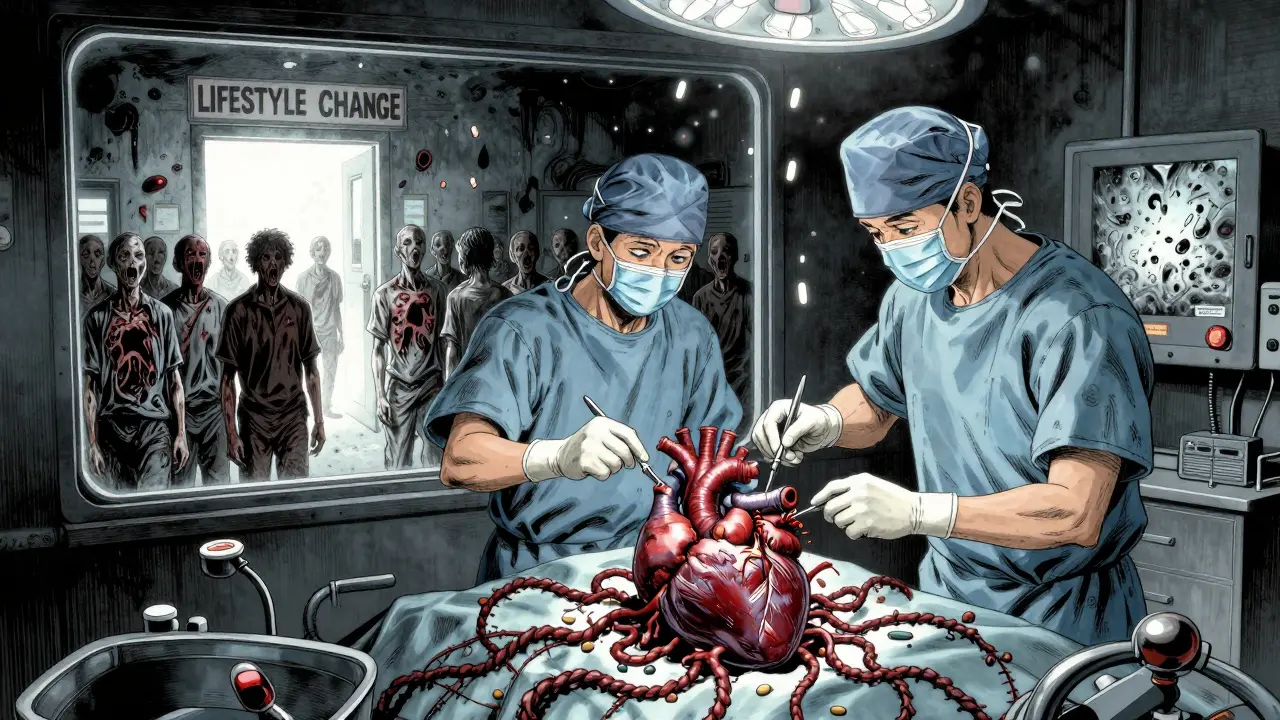
The New Frontier: Cardio-Oncology
More people are surviving cancer. More are living with heart disease. And now, more are surviving both. That’s where cardio-oncology comes in.
Certain cancer treatments-chemotherapy, radiation, targeted drugs-can damage the heart. A woman treated for breast cancer with radiation might develop coronary artery disease 10 years later. A man on immunotherapy for melanoma might develop heart inflammation. Doctors now work together: cardiologists and oncologists sharing records, adjusting medications, and monitoring heart health during cancer treatment.
This isn’t a niche field anymore. It’s becoming standard care. If you’re fighting cancer and have heart disease-or risk factors for it-ask your team about a cardio-oncology consult.
What’s Next?
The future of CAD treatment is personalization. The 2023 guidelines stress that treatment intensity should match your risk level. A 55-year-old with high cholesterol and no other issues might need a statin and lifestyle changes. A 68-year-old with diabetes, kidney disease, and a prior heart attack? They need multiple medications, aggressive monitoring, and possibly a stent.
Researchers are also studying new ways to stabilize plaques before they rupture. Blood tests that measure inflammation (like hs-CRP) are becoming more common. Imaging tools that show plaque composition-rather than just narrowing-are starting to appear in major hospitals.
One thing is clear: coronary artery disease is preventable, treatable, and often reversible-if you act early. You don’t need to wait for chest pain. If you have risk factors, get tested. If you’re diagnosed, stick with your plan. Your heart doesn’t ask for perfection-it just asks for consistency.

Arlen Whitlock
My name is Arlen Whitlock, and I am an expert in the field of pharmaceuticals. With a deep passion for understanding medications and their effects on various diseases, I have dedicated my life to researching and developing innovative drug therapies. I also have a keen interest in dietary supplements and their potential interactions with medication. Sharing my knowledge and insights with others is one of my greatest passions, and I fulfill this by writing about the latest advancements in medication, the treatment of various diseases, and the role of supplements in health. Through my work, I hope to contribute to the betterment of public health and the well-being of patients around the world.
So let me get this straight - we’re telling people to eat kale and quit smoking like it’s 2008? Meanwhile, Big Pharma’s already got a new pill ready to sell us for ‘unstable plaques’ that we didn’t even know we had until this article.
Also, ‘cardio-oncology’? Sounds like a Netflix documentary about people who survived chemo only to get a stent. I’m in. 🤡
Appreciate the breakdown on plaque types - most people think it’s just about cholesterol levels, but the real danger is inflammation and cap thickness. That’s why statins work beyond just lowering LDL. They stabilize. That’s huge.
Also, the calcium score CT is underused. If you’re over 40 and have any risk factors, get one. It’s cheap, non-invasive, and way more telling than a standard lipid panel.
YESSSS this is the kind of info we NEED 😍
Just last week my cousin got told he had ‘borderline’ cholesterol and was like ‘I’ll just eat less pizza’ - bro, he’s got diabetes, smoking history, and a BMI of 34. He needs a PLAN, not pep talks.
Statins aren’t optional. They’re life insurance. And yes, you can still have pizza. Just not every damn night. 💪❤️
They say ‘unstable plaques’ - but what if the whole system is rigged? 🤔
What if the ‘LDL = bad’ thing is a lie pushed by Big Pharma to sell statins? What if plaque buildup is just your body’s way of patching up damaged arteries from processed foods and toxins?
They don’t want you to know that heart disease is preventable with sunlight, fasting, and magnesium. They want you hooked on pills. 🧠💊
Check out Dr. Kendrick’s YouTube. He’s the real deal.
So many people think ‘I’m fine’ until they’re not. I’ve seen it too many times.
One guy I know - 52, no symptoms, ate like a champ, never exercised - had a massive heart attack on a treadmill in the gym. Turns out his calcium score was 1,200. He didn’t even know.
Don’t wait for chest pain. Get screened. Talk to your doc. Even if you think you’re healthy - you might not be. ❤️
Plaque vulnerability is a biophysical phenomenon driven by endothelial dysfunction and macrophage polarization. The 2023 ACC/AHA guidelines reflect a paradigm shift from stenosis-centric to plaque-centric risk stratification.
Statins modulate IL-6 and CRP pathways - not just LDL. SGLT2i and GLP-1RA demonstrate pleiotropic effects on myocardial energetics and fibrosis - independent of glycemic control.
Early intervention is non-negotiable.
Stop with the fluff. You don’t need a 2000-word essay to say this: if you smoke, have diabetes, or are fat - fix it. Or die. Simple. No magic pills. No fancy scans. Just quit sugar. Quit smoking. Move. Eat real food.
Everything else is just noise from people who don’t want to change.
OMG I JUST READ THIS AND I CRIED 😭
My dad had a heart attack last year and they said he was fine… but he had 3 blockages and didn’t even know!! I’m so mad at doctors they don’t tell people!!
I told my mom to stop eating biryani and she said I’m mean 😭
PLZ HELP PEOPLE
Thank you for this comprehensive and clinically grounded overview. The integration of risk stratification, imaging modalities, and emerging pharmacotherapies reflects a maturation of cardiovascular care that prioritizes precision over protocol.
I particularly appreciate the emphasis on non-invasive diagnostics and the role of SGLT2 inhibitors - a landmark shift in therapeutic paradigms that transcends diabetes management.
Well-researched and essential reading.
Why are we letting foreigners tell us how to live? In America we eat meat, we work hard, we don’t take pills. This is all socialist BS.
My grandpa smoked 3 packs a day and lived to 92. You’re all weak.
Get off the internet and go lift something.
I wonder if we’re treating the symptom instead of the cause. What if plaque isn’t the enemy - what if it’s the body’s attempt to heal? Maybe the real issue is chronic stress, loneliness, and disconnection from nature.
We fix arteries with stents but never fix the soul.
wait so… statins are for like… EVERYONE?? i thought only old people needed them?? i’m 34 and my doc said i’m ‘borderline’ and i was like… oh cool…
so now i’m scared lmao
They say ‘act early’… but what if early is too late? What if we’re all just slowly dying, and medicine just delays the inevitable? I’ve seen too many people fight, take their pills, eat their kale… and still go.
Maybe it’s not about control. Maybe it’s about acceptance.
Heart disease isn’t a disease. It’s a societal failure. We built systems that reward speed over sustainability. We glorify burnout. We treat the body like a machine that can be fixed with a part.
But the heart isn’t a pump. It’s a mirror. What you feed it - emotionally, spiritually, physically - it reflects back.
Stents won’t heal a broken spirit.