
Colesevelam Constipation Risk Calculator
Your Risk Assessment
Your Risk Assessment
Recommended Management
- Start with low dose (1.25g) and increase slowly
- Drink 8+ glasses of water daily
- Add 5g psyllium husk (Metamucil) daily
- Take with meals to reduce bloating
When you're taking colesevelam for diabetes or high cholesterol, the last thing you want is to feel bloated or stuck. It’s a common problem - and it’s not just in your head. About 1 in 10 people on colesevelam (brand name Welchol or Cholestagel) report constipation. Bloating and gas are almost as common. These aren’t minor annoyances. For some, they’re serious enough to make people stop taking the medication altogether.
Why Does Colesevelam Cause Constipation?
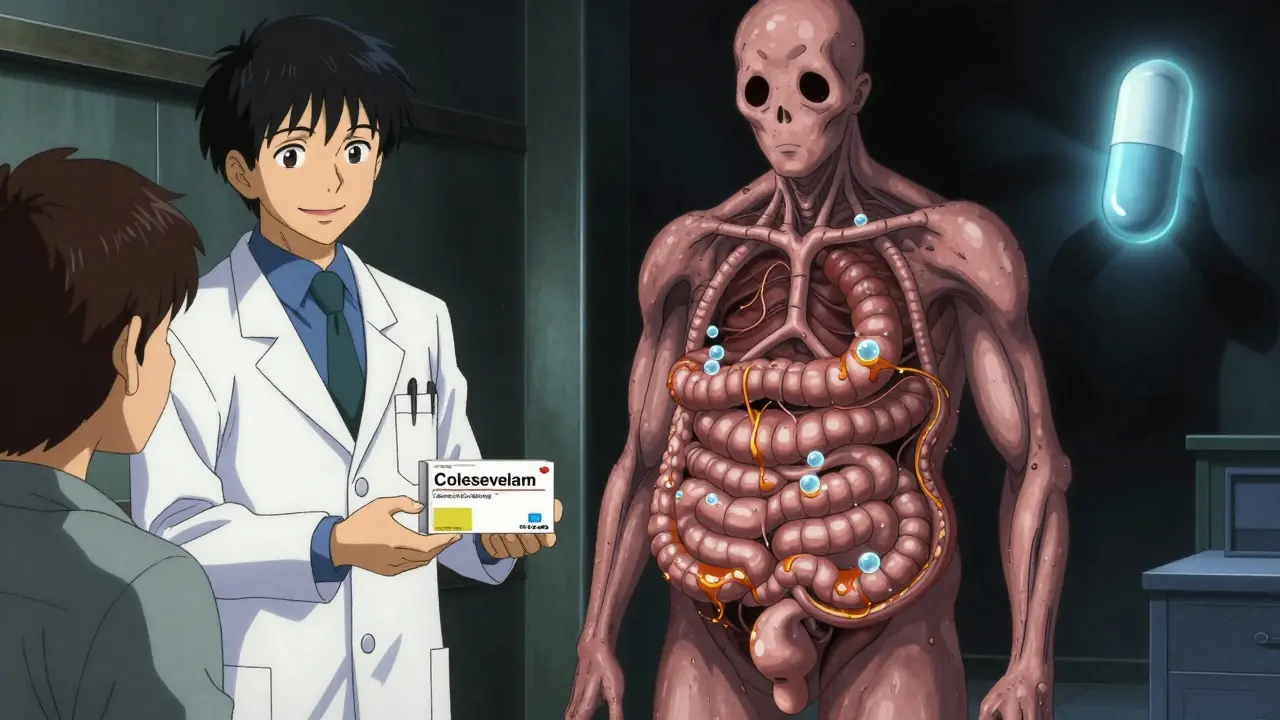
Colesevelam works by binding bile acids in your gut. That’s how it lowers cholesterol and helps with certain types of diarrhea. But here’s the twist: the same mechanism that fixes loose stools can turn normal ones into hard, difficult-to-pass ones. It’s like a sponge soaking up too much water - your stool gets drier, slower, and harder to move.
Unlike older bile acid binders like cholestyramine, colesevelam was designed to be gentler. It doesn’t form gritty clumps. Instead, it turns into a soft, gel-like substance. That’s why it’s better tolerated overall. But it still pulls water out of your colon. And if you’re already prone to slow digestion, that’s a recipe for trouble.
Studies show about 10-15% of users develop constipation. That’s lower than cholestyramine (up to 39%), but it’s still a real risk. The problem gets worse if you already have slow bowel movements, a history of constipation, or take other meds that slow digestion - like opioids or some diabetes drugs.
When Constipation Becomes Dangerous
Most people just feel a bit backed up. But for some, it escalates. There are documented cases of people ending up in the ER with fecal impaction after starting colesevelam. That’s when stool gets so hard and packed that it blocks the rectum. It’s rare, but it happens - especially in older adults or those with pre-existing bowel issues.
The Mayo Clinic and other medical guidelines clearly warn: don’t take colesevelam if you have a bowel obstruction, severe chronic constipation, or a motility disorder. If you’ve had trouble with constipation before, this drug might not be right for you - or you’ll need to start low and go slow.
How to Manage Constipation While Taking Colesevelam
You don’t have to quit the drug if you get constipated. There are proven ways to manage it.
- Start low, go slow. Don’t jump to the full dose. The Royal Marsden Hospital recommends starting with 1.25 grams (two 625 mg tablets) once a day. After 7 days, increase to 2.5 grams. After another week, go to 3.75 grams. This gives your gut time to adjust.
- Drink more water. Colesevelam soaks up fluid. If you don’t replace it, your stool dries out. Aim for at least 8 glasses of water daily. Warm water in the morning can help kickstart your bowels.
- Add soluble fiber. Psyllium husk (Metamucil) is the top choice. It adds bulk without making things worse. One patient with bile acid malabsorption after cancer treatment said they needed 17 grams of psyllium daily to stay regular. Start with 5 grams and increase slowly. Don’t use insoluble fiber like wheat bran - it can irritate your gut.
- Try a stool softener. Docusate sodium (Colace) is safe to use with colesevelam. It helps water stay in your stool. Avoid stimulant laxatives like senna or bisacodyl. They can cause cramping and electrolyte problems.
- Use prune juice. It’s a natural, gentle option. Half a cup in the morning can help. The sorbitol in prune juice draws water into the colon.
One study found that 30% of people who initially got constipated could keep taking colesevelam just by adjusting their dose and adding fiber. That’s not a small number - it means most people can stay on the drug if they manage it right.

What About Bloating and Gas?
Bloating and flatulence affect about 11% of users. It’s not dangerous, but it’s embarrassing and uncomfortable. The good news? It often improves after a few weeks.
Take your dose with meals. Eating helps reduce gas buildup. Avoid carbonated drinks and chewing gum - they make you swallow air. If bloating sticks around, try simethicone (Gas-X). It breaks up gas bubbles and is safe to use with colesevelam.
Don’t confuse bloating with a bowel blockage. If you haven’t had a bowel movement in 3 days, feel severe pain, or start vomiting, call your doctor. That’s not normal bloating - it could be something serious.
Who Should Avoid Colesevelam?
Not everyone is a candidate. Avoid colesevelam if you have:
- History of bowel obstruction
- Chronic constipation (Bristol Stool Scale score ≤3)
- Gastrointestinal motility disorders
- Allergy to any ingredient in the tablet
Also, don’t take it within 4 hours of other medications. It can bind to them and stop them from working. That includes thyroid meds, birth control pills, and some diabetes drugs. Space them out - take colesevelam with your biggest meal, and take other pills either 4 hours before or after.
How Does Colesevelam Compare to Other Drugs?
Compared to older bile acid binders, colesevelam is better. Cholestyramine causes constipation in up to 39% of users. Colestipol isn’t much better. Colesevelam? Around 12%. That’s why it’s now the first-choice drug for bile acid diarrhea in the U.S. and Europe.
It’s also more expensive - $300 a month versus $50 for cholestyramine. But because fewer people quit due to side effects, it ends up saving money on doctor visits and hospital trips. In real-world use, 12% of people stop colesevelam because of side effects. For cholestyramine, it’s 29%.
Newer drugs like elobixibat are coming, but they’re not available everywhere. For now, colesevelam remains the best balance of effectiveness and tolerability - if you manage the GI side effects well.
What’s Next for Colesevelam?
Researchers are working on smarter ways to use it. A new test called serum C4 measures bile acid production. If your C4 level is low, you’re more likely to get constipated on colesevelam. That means doctors might soon test you before prescribing it - and avoid giving it to people at high risk.
Sanofi is also developing a new version of colesevelam that releases slowly in the gut. Early trials suggest it might reduce constipation by avoiding high concentrations in the upper intestine. That could be a game-changer.
For now, the key is knowing your body. If you’ve had constipation before, tell your doctor. Start with half the dose. Add fiber and water. Monitor your stools. Most people find a balance - and get the benefits without the misery.
Can colesevelam cause severe constipation?
Yes, in about 10-15% of users. It’s usually mild, but in rare cases, it can lead to fecal impaction - especially if you have a history of chronic constipation, slow bowel movements, or are taking other constipating medications. If you haven’t had a bowel movement in 3 days, contact your doctor.
Is it safe to take fiber supplements with colesevelam?
Yes - and it’s often recommended. Soluble fiber like psyllium husk helps add bulk and retain moisture in stool, which counteracts colesevelam’s drying effect. Take fiber at least 2 hours apart from colesevelam to avoid binding. Avoid insoluble fiber like wheat bran, which can irritate the gut.
Why does colesevelam help diarrhea but cause constipation?
It binds bile acids in the gut. In people with bile acid malabsorption (like after gallbladder removal or radiation), excess bile causes watery diarrhea - so binding it helps. But in people with normal bile flow, binding bile reduces water in the colon, leading to harder stools. It’s the same mechanism, opposite outcomes based on your body’s condition.
Can I take laxatives with colesevelam?
Stool softeners like docusate sodium are safe. Avoid stimulant laxatives like senna or bisacodyl - they can cause cramps and electrolyte imbalances. Always check with your doctor before starting any new laxative.
How long does it take for bloating to go away on colesevelam?
For most people, bloating and gas improve within 2-4 weeks as the body adjusts. If it persists beyond that, try taking the drug with meals, avoiding carbonated drinks, and using simethicone. If symptoms don’t ease, talk to your doctor about adjusting your dose.
Should I stop colesevelam if I get constipated?
Not necessarily. Many people can continue taking it by adjusting their dose, adding fiber, and drinking more water. About 30% of those who initially get constipated can stay on the drug with proper management. Only stop if you have no bowel movement for 3 days, severe pain, or vomiting - and then call your doctor first.
Final Thoughts
Colesevelam is a powerful tool for managing cholesterol and bile acid diarrhea. But its side effects are real - and manageable. The key isn’t avoiding the drug. It’s understanding how it works in your body and working with your doctor to find your personal balance.
If you’ve been told to take it and you’re worried about constipation, don’t wait until it gets bad. Start with a low dose. Add water and psyllium. Track your bowel habits. Talk to your doctor before you stop. You don’t have to choose between control and comfort - you can have both, if you manage it right.

Harrison Duncombe
I have been working in the pharmaceuticals industry for over two decades and have developed a passion for medications and their impact on health. I enjoy researching new treatments and writing about their effects on diseases. Sharing my knowledge about supplements is something I find fulfilling. Through my work, I aim to provide valuable insights and guidance to those seeking understanding in this complex field.
I took this stuff for 3 weeks and it turned my gut into a concrete mold. No joke. I was literally stuck. My doctor said 'just drink more water' like I'm a damn cactus. I quit. No regrets. Life's too short to poop like a robot.
I was terrified to start colesevelam because I have IBS-C but my endo insisted it was my best bet for LDL. I started at 1.25g, added 5g psyllium in the morning with 2 big glasses of water, and now I'm regular. It took 10 days but it worked. Don't give up too soon. You got this 💪
Constipation risk is documented. Fecal impaction is a known adverse event. Protocol requires exclusion in patients with bowel obstruction. Compliance with dosing instructions is critical.
It's rather unfortunate that the average patient lacks the intellectual capacity to comprehend the mechanistic duality of bile acid binding-how it can be therapeutic in one context and iatrogenic in another. One must possess a certain baseline of physiological literacy to navigate such pharmacological nuances without resorting to crude self-diagnosis.
Bro. You're telling me you're taking a sponge that soaks up your guts' water and you're surprised you're constipated? I mean... come on. That's like filling your car with diesel and then wondering why it won't start in the snow.
I started at full dose because I was impatient and now I haven't pooped in 5 days and I'm sweating and dizzy and my stomach is bloated like a balloon and I'm not joking I think I might be dying and I'm scared to go to the ER because I don't want to be that guy who cried wolf but I think I need help
I have been on colesevelam for 8 months now. Started with 1.25g, added psyllium, drank 3L water daily. Now I am regular and my cholesterol is down. In India, many people don't drink enough water. This medicine requires discipline. But it works. 🙏💧
I took this in Dubai after my gallbladder removal. Bloating was bad at first. Started taking it with meals, avoided soda, used Gas-X. Now I'm fine. Sometimes you just need to adapt. Culture matters too-here we eat dates and figs, natural fiber. Works better than pills sometimes 🌴